Digital-Ḍād ض-الرقمية: Arabic OCR Handwriting Recognition
An innovative Arabic handwriting recognition system powered by CNN and Bi-LSTM neural networks, featuring a modern React interface.
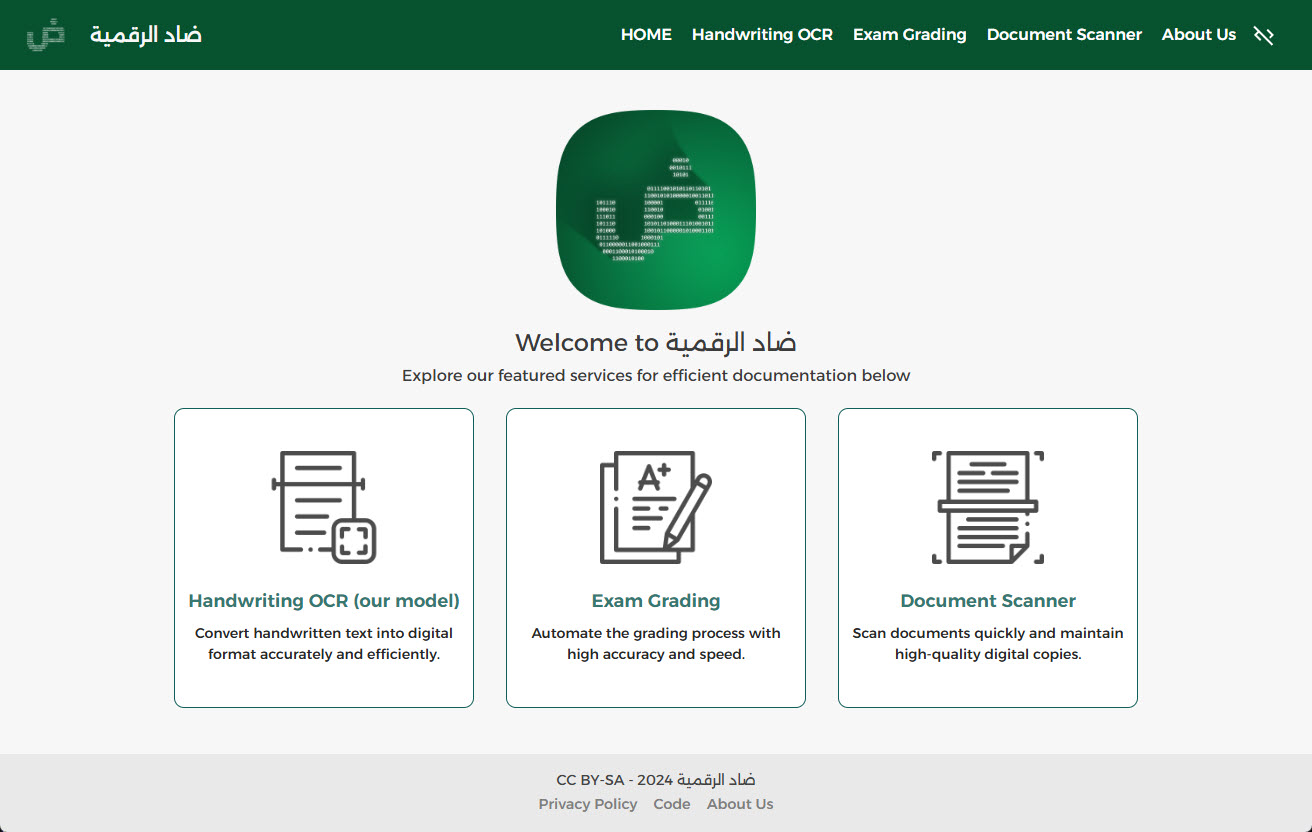
Digital-Ḍād ض-الرقمية: Arabic OCR Handwriting Recognition
Digital-Ḍād ض-الرقمية is a comprehensive solution designed to tackle one of the most challenging aspects of optical character recognition: deciphering Arabic handwritten text. This project combines advanced deep learning techniques with a custom-built dataset to deliver unparalleled accuracy in recognizing complex Arabic scripts.
Overview
Arabic handwriting poses unique challenges due to its cursive nature, varying styles, and contextual letter shapes. Conventional OCR systems often struggle with these nuances, resulting in lower accuracy and reliability. Digital-Ḍād ض-الرقمية addresses these challenges by employing a state-of-the-art model that integrates Convolutional Neural Networks (CNNs) with Bidirectional Long Short-Term Memory (Bi-LSTM) networks, achieving a notable accuracy improvement—from an 87% baseline to an impressive 97%.
The Challenge
Traditional OCR solutions are usually optimized for printed text and standard fonts. However, when it comes to handwritten Arabic:
- Variability in Writing Styles: No two handwriting samples are exactly alike, making it difficult for standard models to generalize.
- Context Sensitivity: Arabic characters change shape depending on their position in a word.
- Limited Datasets: There is a scarcity of large, annotated datasets for Arabic handwriting, which hampers training robust models.
These factors necessitated a tailored approach, one that could learn from a vast and diverse dataset and adapt to the fluid nature of handwritten Arabic.
Our Approach
Digital-Ḍād ض-الرقمية is built on the following pillars:
-
Custom Dataset Creation:
We compiled and preprocessed a dataset exceeding 100,000 samples, capturing a wide variety of handwriting styles. This diverse collection ensures that the model can generalize well across different contexts and writing habits. -
Deep Learning Architecture:
The backbone of our system is a hybrid model that leverages:- CNNs for effective feature extraction from raw images.
- Bi-LSTM networks to capture the sequential nature of Arabic script, allowing the model to understand context and improve character recognition.
-
Rigorous Preprocessing:
Advanced preprocessing techniques were applied to the raw images to normalize variations, reduce noise, and enhance the clarity of the handwriting, which is crucial for improving model accuracy. -
Iterative Training and Validation:
Through extensive experimentation, the model was fine-tuned to maximize recognition accuracy. The result is a system that consistently delivers a 97.04% accuracy rate—a significant leap over previous methods.
Key Features
- High Accuracy:
Achieves a character error rate as low as 2.96%, marking a substantial improvement in recognizing handwritten Arabic. - Robust to Variability:
Designed to handle the inherent variability in Arabic handwriting, ensuring consistent performance across different writing styles. - User-Friendly Interface:
The front-end is implemented using React, providing an intuitive and responsive experience for scanning, recognizing, and grading handwritten exams. - Scalable and Adaptable:
While initially developed for academic use, the system is adaptable to various applications, from educational assessments to historical document digitization.
Technical Details
Digital-Ḍād ض-الرقمية harnesses the synergy between CNNs and Bi-LSTM networks:
- CNNs: Extract spatial features from input images, identifying key patterns in handwriting strokes.
- Bi-LSTM Networks: Process these features in both forward and backward directions to capture context, enabling the model to predict characters more accurately.
This combination ensures that even subtle nuances in handwriting are captured and correctly interpreted.
Impact and Recognition
The innovative approach behind Digital-Ḍād ض-الرقمية has not only resulted in a practical solution for Arabic handwriting recognition but also contributed to academic discourse. The research was presented at the "Artificial Intelligence: Future Prospects for Achieving the Sustainable Development Goals" Conference in 2024 and has been published in the International Journal of Telecommunications. These recognitions underscore the potential of our approach to transform how handwritten Arabic is processed and understood.
Getting Started
For those interested in exploring or contributing to Digital-Ḍād ض-الرقمية, the project is open source and available on GitHub. Whether you're a researcher, developer, or enthusiast, you can check the GitHub repository for more information.